Why Tree Crews Refuse to Work Near Power Lines
If a tree crew tells you the work near a power line is not theirs to do, that is the right answer. Here is why, and how to get the job done correctly.
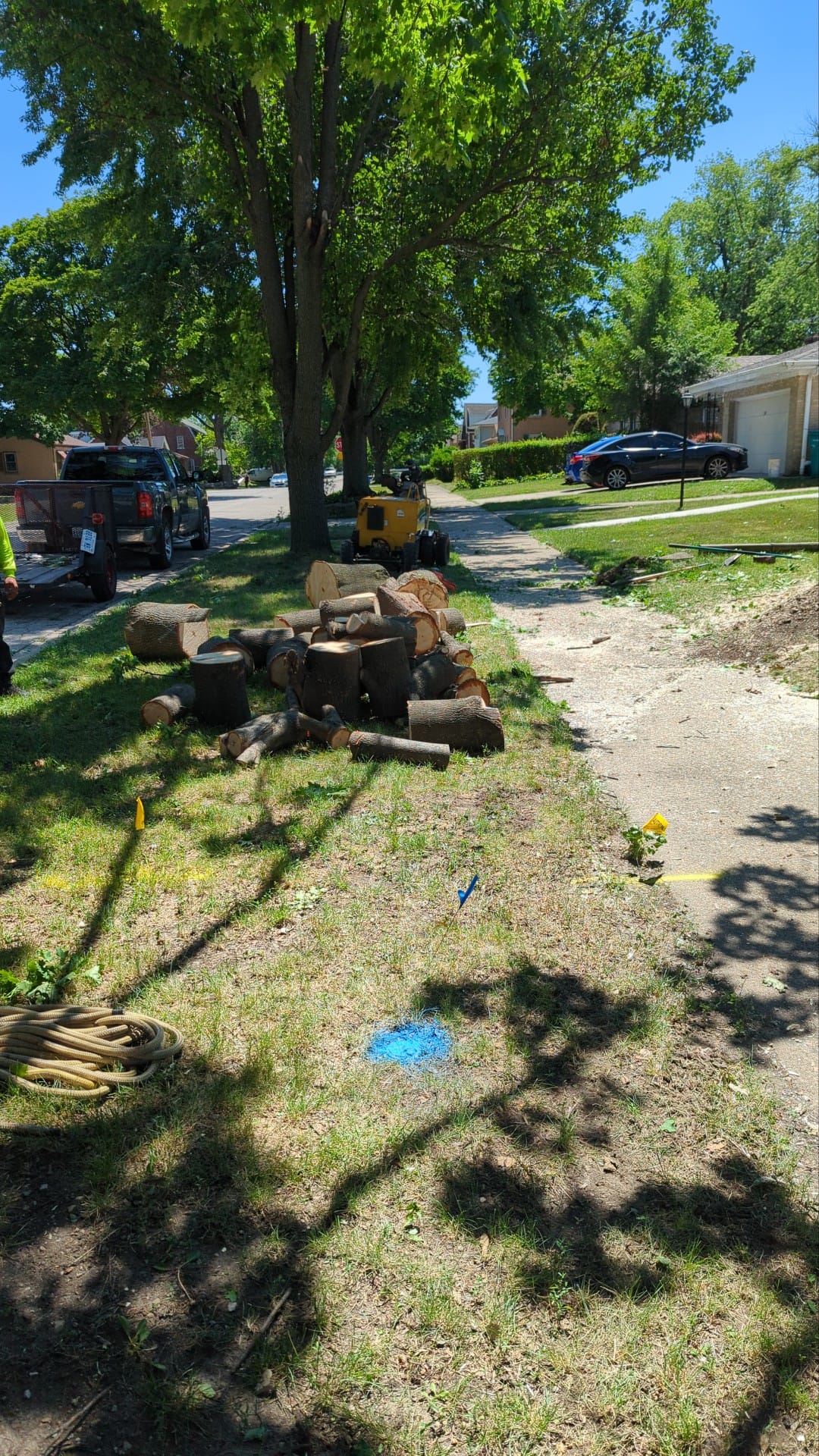
Every season we get the same call. A homeowner has a tree growing into a service line, a branch resting on the wires to the house, or a larger tree along the back of the property that has gotten tangled with the distribution lines along the road. The expectation is that any tree service can climb up and trim it back. The honest answer is that most of those jobs are not residential tree work at all, and a crew that says yes without the right qualifications is putting themselves and the homeowner in serious trouble.
The reason has nothing to do with the chainsaw. It has to do with what happens when something conductive gets within reach of an energized line. Electricity does not need to make direct contact with a person to do harm. It can arc through air at distances that surprise people, especially in humid weather. A long branch, a wet rope, an aluminum ladder, a steel pole pruner, or even a tall worker standing in the wrong place can carry enough current to kill instantly. Utility lines along streets and feeders behind houses are running at thousands or tens of thousands of volts, far above what the household wiring inside the house carries. There is no safe margin for guessing.
The framework that governs this work is something called minimum approach distance, and it is set by the type of line and the qualifications of the worker. A general tree-care crew is required to keep all parts of themselves and their tools well outside that distance unless they are specifically trained, certified, and equipped as line-clearance arborists. That qualification is a different category from a normal tree-care certification and involves dedicated training, gear, and an entirely different way of approaching the job. Most residential tree services, including ours, do not perform line-clearance work, and that limit exists for good reasons.
The work also depends on what the line actually is, and homeowners often cannot tell. The thick high-voltage primary lines at the top of a utility pole are the most dangerous. The thinner secondary lines below them are less dangerous but still very capable of killing a worker. The service drop running from the pole to the side of your house is lower voltage but still well above anything a residential crew should be in contact with. Cable, phone, and fiber lines look similar from a distance but carry essentially no electrical risk. Mixing those categories up, especially by relying on color or thickness alone, is exactly how serious accidents happen.
There are also liability and insurance dimensions that matter to the homeowner. If a general tree crew touches a primary line and causes an outage, the cost of the resulting investigation, repairs, and downstream damage can be enormous, and the homeowner can end up part of the conversation. If somebody is hurt or killed, the situation becomes a different category of problem entirely. The crews that work on power lines correctly are insured, licensed, and trained specifically to manage that risk. The crews that do not should not be approaching that work, and any reputable tree service will say so.
The right path for a homeowner with a tree problem near a line depends on which line is involved. For trees touching or threatening the primary or secondary lines along the street or behind the property, the call goes to the utility company. The utility will dispatch their own line-clearance contractors at no cost in most regions, because keeping vegetation off the system is part of their normal operations. For trees touching the service drop into the house, the conversation is a little more nuanced. Some utilities will temporarily de-energize and disconnect the drop so a tree crew can safely work, then reconnect afterward. That is the gold-standard procedure for service-drop work and is worth the extra coordination on the homeowner's part.
For everything not in contact with an energized line, a normal tree crew can handle it. We can prune, remove, or shape a tree near a line as long as the work itself stays outside the minimum approach distance and there is no realistic risk of pieces falling into the line. If the work cannot meet that condition, the right move is to set it up properly with the utility first and then do it safely, not to crash through the job and hope nothing goes wrong. A crew that says no to a line-side job is doing it right. A crew that says yes without the right setup is the one to walk away from.
Need tree service?
Klein Creek Tree Care LLC helps residential and commercial properties with trimming, pruning, removals, storm cleanup, and safety-focused maintenance.