Cabling and Bracing: What Tree Support Can and Can't Fix
Support systems can extend the life of a valuable tree with a weak union or a heavy limb, but they work best when the defect is caught early and the rest of the tree is sound.
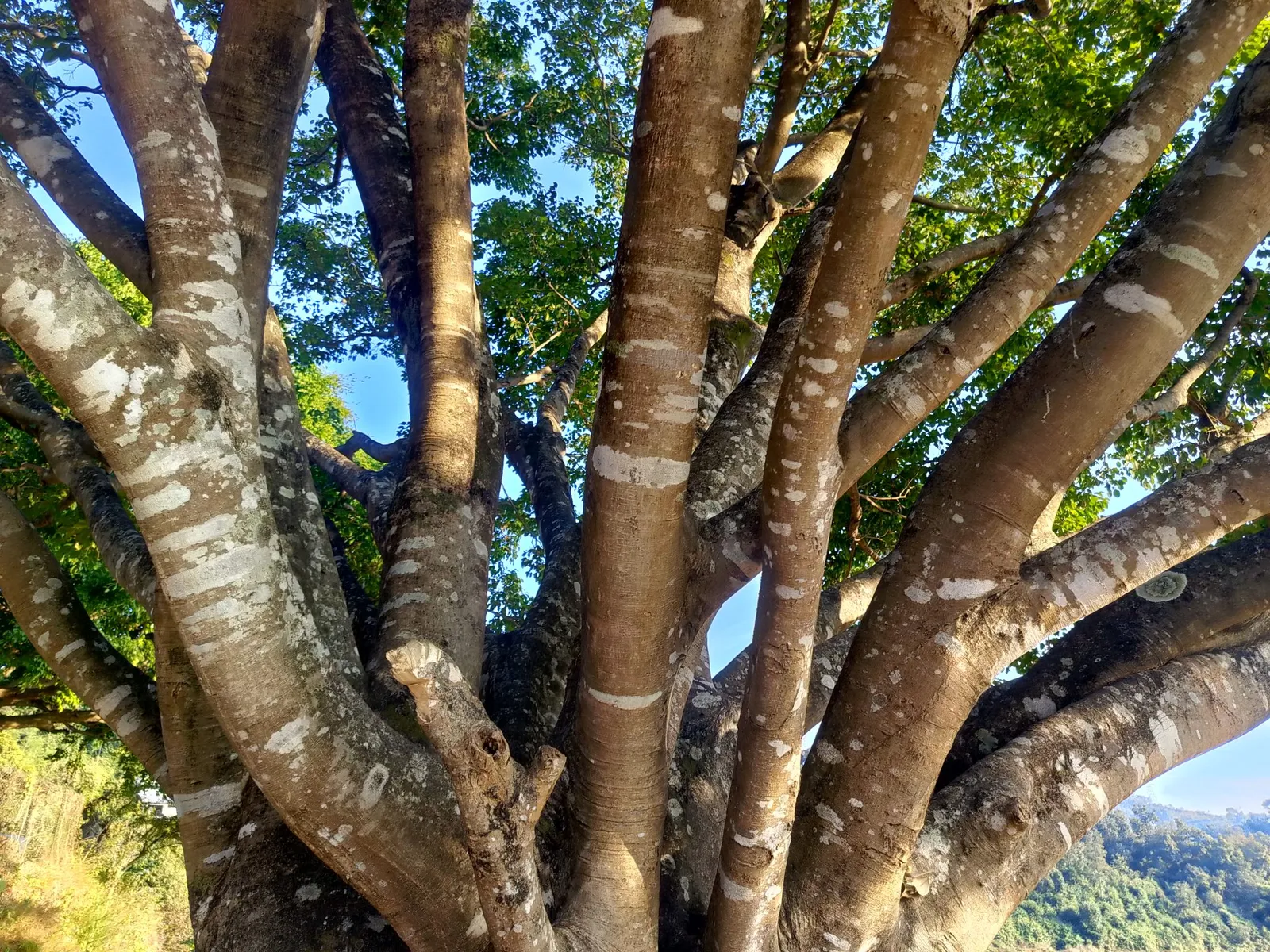
Some trees grow into a shape that makes them more likely to split: two or more trunks rising from the same point, a heavy limb reaching far over a roof, or a fork where bark is trapped between the stems instead of forming a solid connection. When the tree is healthy and worth keeping, removal is not the only answer. Cabling and bracing add mechanical support so a weak point does not carry the full load of wind, snow, and ice on its own. With winter on the way in DuPage County, fall is a practical time to decide whether a tree with a known defect needs that help.
A cable system connects two or more stems or limbs high in the canopy, well above the weak union, often around two-thirds of the way from the union to the branch tips. When wind pushes one stem away from the other, the cable shares the load and limits how far the union can be pried apart. Traditional systems use steel cable anchored with hardware installed through the wood. Synthetic systems use a strong, rope-like material that allows some movement in normal conditions and takes up the load as the stems spread. Each type has trade-offs in strength, flexibility, and installation, and the right choice depends on the species, the size of the stems, and the defect being addressed.
Bracing works differently. Threaded steel rods are installed through the stems, typically near a weak union, to hold the wood together and limit twisting. Rods are often combined with cables: the rod stabilizes the union itself, while the cable higher up reduces the leverage working against it. Bracing is sometimes used on a union that has begun to crack, but only after a careful evaluation, because a crack that has spread far or opened into decay may be past the point where hardware is a sensible fix.
Support systems are most useful on trees with co-dominant stems, unions with included bark, long horizontal limbs over driveways, patios, or roofs, and multi-stem ornamentals that splay open under snow. They can also buy time for an important tree near a home while the owner plans for its future. Cabling is usually paired with pruning. Shortening a heavy stem and reducing the weight at its end lowers the load the system has to carry, which is better for both the tree and the hardware.
There are clear limits. A cable will not save a tree with extensive trunk decay, a failing root system, a lean caused by root damage, or a large dead section. It does nothing for problems at the base of the tree or below ground. It also does not make a tree failure-proof; it lowers the likelihood of one specific failure at one specific point. If an evaluation shows that the tree's risk stays high even with support, removal or a significant reduction may be the more responsible recommendation, and a good arborist will say so.
Support hardware is not install-and-forget. Trees grow, hardware wears, and a cable can go slack or become too tight as stems thicken. Plan on periodic inspections and a check after major storms. You can keep an eye on it from the ground, too: a cable that is suddenly loose, rubbing on bark, or being swallowed by new growth is worth a call. Keep a record of when the system was installed and what was done, because that history helps whoever inspects it next.
Before agreeing to a support system, ask the arborist to explain the specific defect being addressed, why support is preferred over pruning alone or removal, what type of hardware will be used and where, what pruning will go with it, and how often it should be inspected. Clear answers to those questions are a good sign the recommendation is built around your tree rather than a standard package.
Klein Creek Tree Care offers cabling and bracing as part of its tree care services in Wheaton, Glen Ellyn, and surrounding communities, and recommends support only after looking at the whole tree, from roots to crown. If you have a split-trunk tree, a heavy limb over the house, or a multi-stem tree that bends badly under snow, a fall evaluation gives you time to decide before the first winter storm.
Worried about a weak union or heavy limb?
Klein Creek Tree Care LLC evaluates trees for cabling, bracing, and structural pruning in Wheaton, Glen Ellyn, and surrounding communities.