Leaf-Off Season: What Bare Branches Reveal About Your Trees
For most of the year, foliage hides what is happening inside a tree's canopy. Late fall is when the structure is laid bare and easiest to evaluate from the ground.
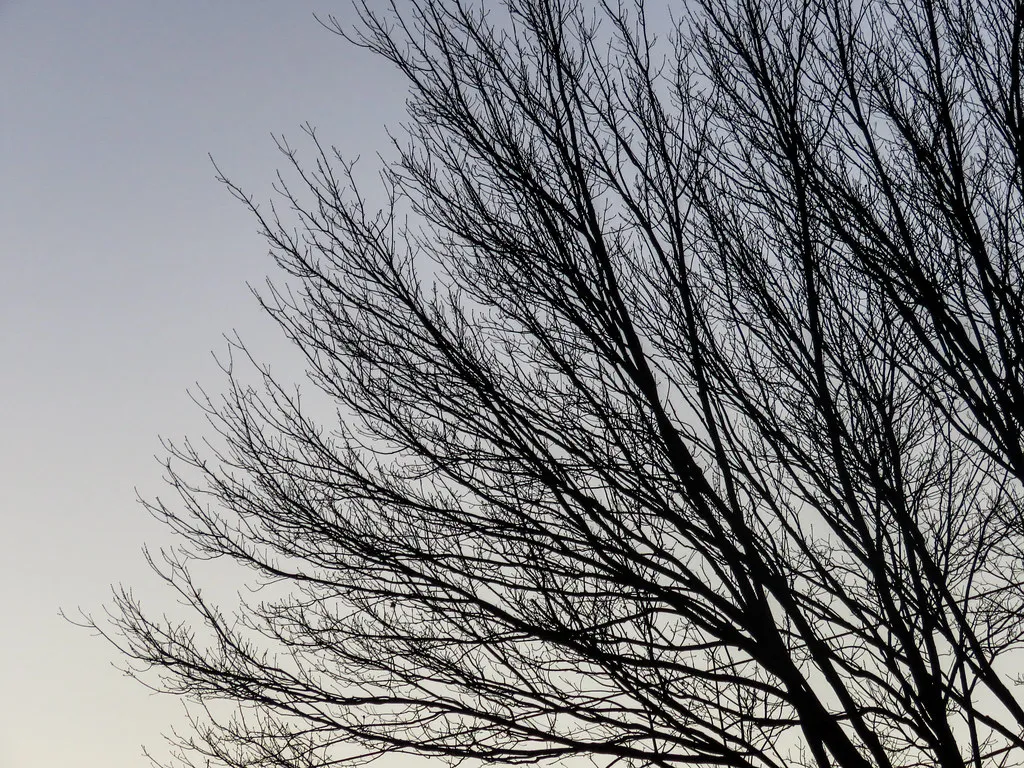
When the last leaves come down in late October and November, the trees around your home look completely different. Without foliage, you can see the outline of the canopy, every major branch, and how those branches attach to the trunk. Arborists value this time of year for exactly that reason. It is also the best time for a homeowner to take a careful look at mature trees and make a list of what may need attention over the winter.
Dead branches are not always obvious once every branch is bare, but there are tells. Live twigs carry plump buds set for spring, have flexible tips, and bark that looks smooth and fresh. Dead branches often have no buds, peeling or missing bark, a grayer color, and broken tips. Branches that held onto brown leaves after the rest of the tree dropped cleanly can mark a limb that died during the season. Large dead limbs over the house, driveway, or play areas belong at the top of the list.
Look for broken branches caught in the canopy, often called hangers. They can stay lodged for weeks and then fall in a windstorm. Scan the unions where large limbs meet the trunk for cracks, seams, or bark that is split or bulging outward. A fork shaped like a tight V, with bark pinched between the stems, is weaker than a broad, U-shaped union. Check the trunk for cavities, missing bark, fungal brackets, or oozing.
Branches that rub against each other wear through the bark and create wounds. Branches growing back into the center of the tree, two stems competing to be the main leader on a mature tree, and heavy limbs reaching far out to one side are all easier to see now. Step back and look at the overall balance: a canopy weighted heavily toward the house or over the street may benefit from reduction pruning.
On ash trees, woodpecker damage that leaves patches of pale, flaked-off bark high on the trunk and branches is a common sign of emerald ash borer, along with small D-shaped exit holes. On other trees, an unusual amount of woodpecker activity in one area can point to insects or decay underneath. Vines climbing into the canopy add weight and hide defects, and are worth removing from trees you want to keep.
Much of what you find can be handled with dormant-season pruning. Pruning while trees are dormant is common practice for many species: the structure is visible, cuts are made before spring growth begins, and many insects and diseases are less active. For oaks in northern Illinois, dormant-season pruning is the usual recommendation to reduce the risk of spreading oak wilt. Maples and birches may drip sap from cuts made in late winter; it looks dramatic, but it generally does not harm the tree.
Take photos of each tree from the same spots and jot down what you noticed. The photos give you a baseline for next year and are useful to an arborist when you request an estimate. Leave the ladder in the garage, though: climbing or working at height with a saw is where most homeowner tree injuries happen, and large limbs behave unpredictably when cut.
Klein Creek Tree Care provides tree trimming, pruning, and tree risk assessments for homeowners in Wheaton, Glen Ellyn, and surrounding communities. If your leaf-off walk-around turned up dead wood, a crack, or a branch you do not like the look of, request an estimate and we will review it with you and recommend what to prune this winter.
Spot something in the bare branches?
Klein Creek Tree Care LLC provides dormant-season pruning and tree evaluations in Wheaton, Glen Ellyn, and surrounding communities.